
Agentforce and AI Agents in Mexico: a real signal for banking, insurance and enterprise
By Inés Rodríguez · co-founder of Hábil and Dorian Chávez · co-founder and CEO of Hábil ·
The conversation is no longer whether generative AI can answer questions, but whether an organization is ready to operate with agents that understand context, data and real processes. For us, that was the most important message from Salesforce Agentforce World Tour Mexico 2026.
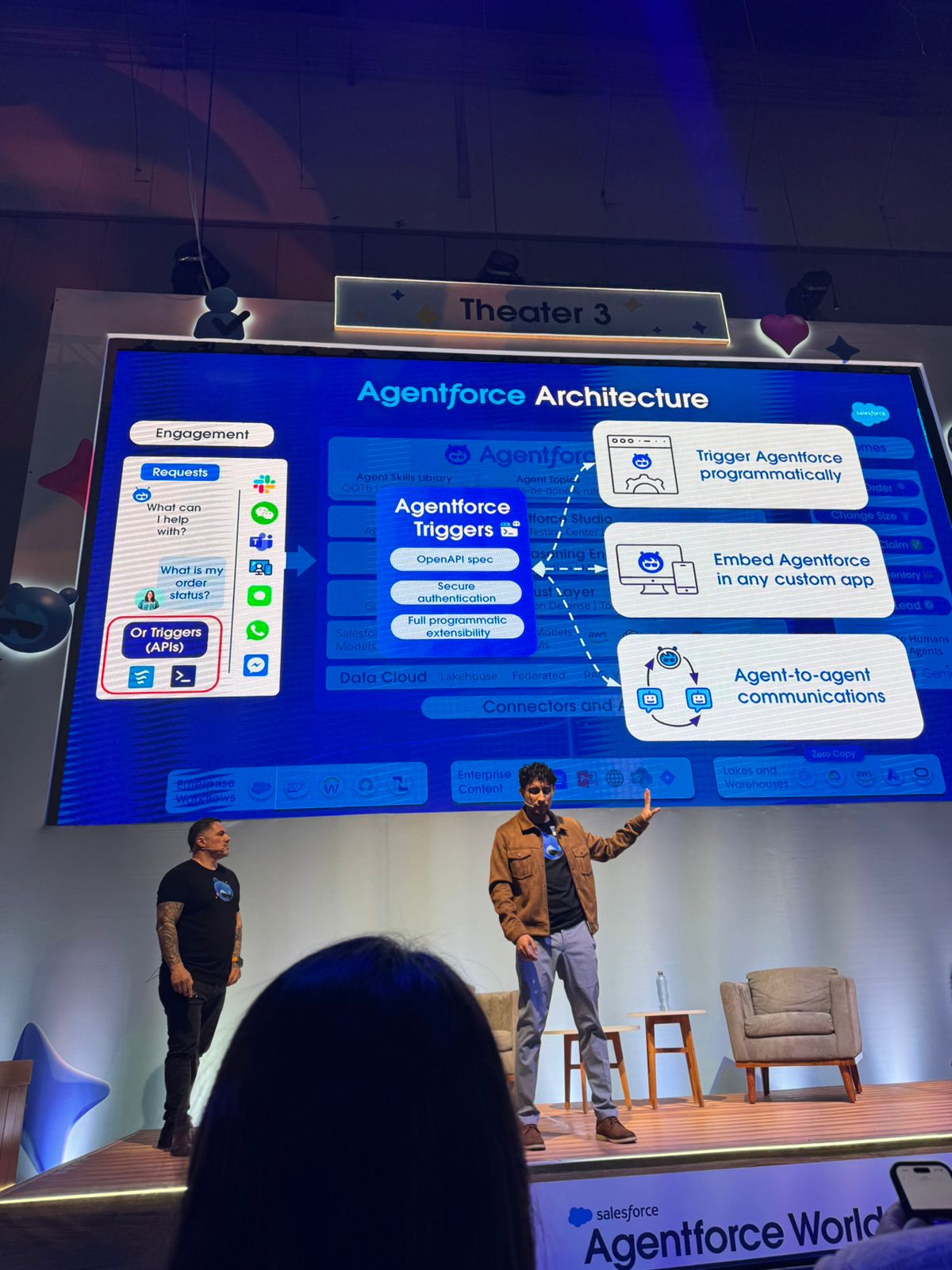
Inés Rodríguez, co-founder of Hábil, attended Salesforce Agentforce World Tour Mexico 2026, and the signal was clear: companies are already evaluating AI agents beyond the conversational interface. Agents can query, propose, route or execute bounded actions; their level of autonomy is set by risk, with least-privilege permissions, human approval where appropriate and a way to roll back.
The most relevant conversation at the event was not "more chat", but how to connect people, applications, data and automation inside daily workflows. In that sense, Agentforce as an agent layer over business processes points in an important direction: AI is moving from demo territory into operations. Slack can be the collaboration interface for certain flows; its value depends on the integration with transactional and identity systems preserving permissions, context and trail.
The problem is not generating answers, but operating with context
In enterprise, answering an isolated question well does not solve much. Value appears when a system can understand customer state, read signals across multiple platforms, prioritize actions and participate in a real flow without breaking traceability, security or governance.
That is the difference between an attractive demo and a serious implementation. A useful enterprise agent does not only talk. It also needs controlled access to correct data, process context, integration with existing systems, business rules, observability and clear limits on what it can and cannot do. Without that, AI becomes a polished layer over fragmented data.
Why so many AI pilots fail when moving to production
Moving a pilot into production tends to reveal what a demo does not expose: data quality and access, integration, accountable owners, controls and ongoing operation. The reason is usually not the model itself. The issue is almost always in the surrounding layer: incomplete or scattered data, non-standardized processes, weak integrations, missing ownership, inflated expectations and no architecture capable of supporting real operations.
In other words, many organizations try to place agents on top of processes that still depend on manual follow-up, disconnected tools and undocumented operational knowledge. When data, rules and owners are inconsistent, an agent reproduces errors at greater speed; that is why operational readiness comes before automation.
Where we do see real value
We see value in cases where context, response time and cross-team coordination directly affect customer experience or efficiency. The most interesting potential is not adding one more chatbot, but orchestrating contextual work in those processes.
In sectors such as banking, insurance and enterprise, that can translate into customer service with unified context, internal operations and productivity, commercial follow-up and customer experience, automation of repetitive tasks, and decision support. The goal is not to replace human judgment, but to help teams decide faster with better context.
In regulated industries, working is not enough
For banking, insurance and organizations with critical operations, the conversation must be stricter. It is not enough for an agent to perform well in a controlled environment. You also need answers to questions such as: where the data came from —the authoritative source, when it was queried, the data used and the system of record that prevails in a conflict—, what action the agent took, who authorized it, how it is audited, how it is constrained, and what happens when context is incomplete or contradictory.
That is where enterprise AI initiatives split into two paths: those that generate sustainable value and those that remain as showcases.
In Mexico, depending on the case and the entity, the design takes into account privacy and financial secrecy, the security and continuity provisions that apply to supervised institutions, and third-party oversight, with enough evidence for an audit.
Our reading after the event
The most valuable part of the event was not confirming that AI momentum is strong. What mattered was seeing the enterprise conversation mature toward more useful topics: context, integration, operations, governance and real productivity.
At Hábil, we believe that is the right opportunity: not chasing hype, but designing and implementing experiences where AI can integrate usefully into complex processes. To make that possible, the right question is not only which model to use, but which architecture, data, flows and controls make an agent viable in production.
In critical processes the goal is not to assume nothing fails, but to design controls that prevent improper actions, detect deviations and escalate exceptions.
Before taking an agent to production, we review five conditions: a bounded use case and risk; authorized data sources; defined permissions and approvals; a trail of every interaction and action; and metrics for quality, impact and escalation. If one is missing, the next step is not to automate: it is to close that gap.
- Hábil AI: AI connected to your systems →
- How to build an MCP for your industry →
- APIs ready for AI agents →
Does your operation face these challenges?
Prefer email? Write to us at hola@habil.mx