
Agentforce and AI Agents in Mexico: a real signal for banking, insurance and enterprise
The conversation is no longer whether generative AI can answer questions, but whether an organization is ready to operate with agents that understand context, data and real processes. For us, that was the most important message from Salesforce Agentforce World Tour Mexico 2026.
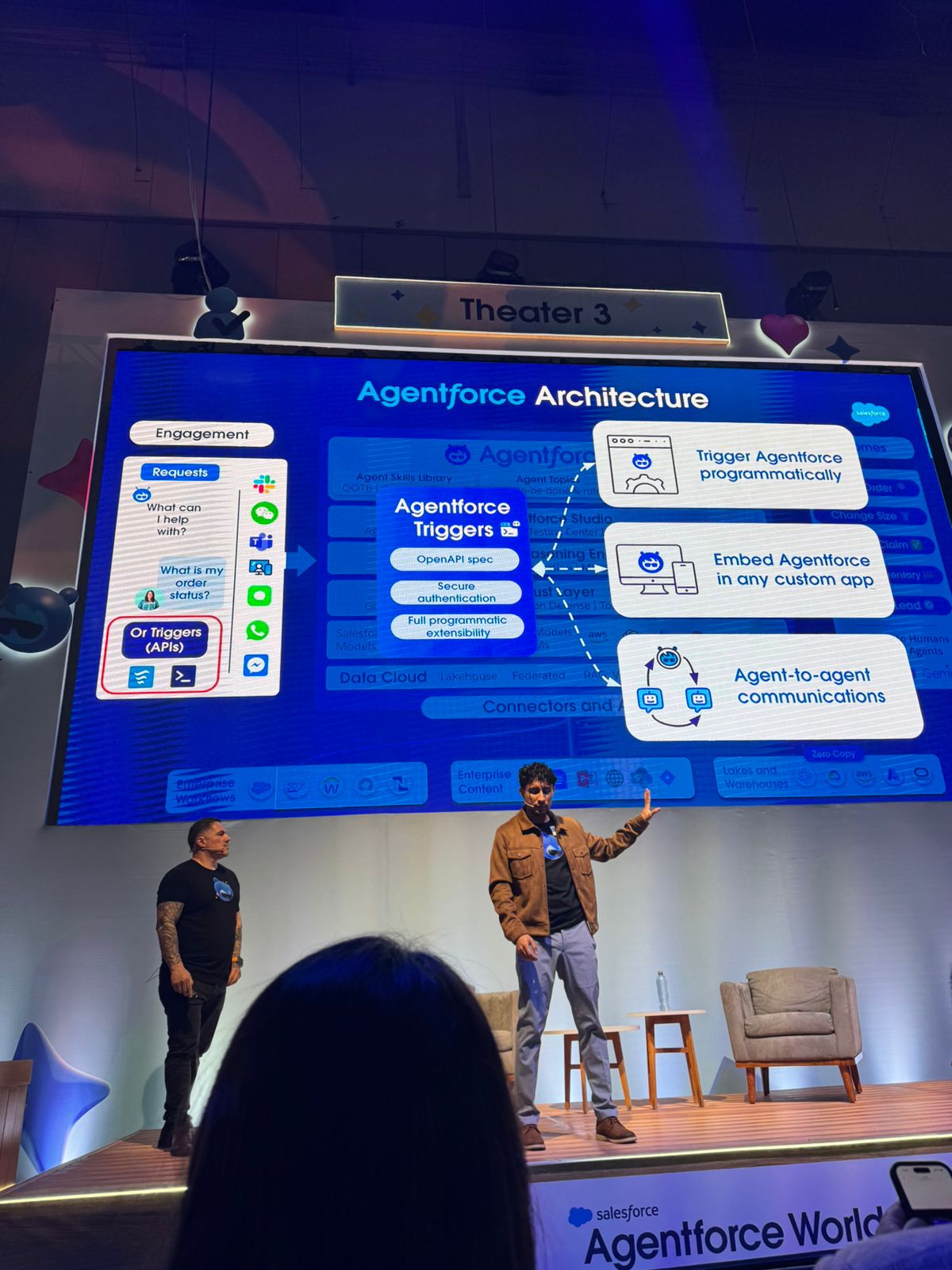
Attending Salesforce Agentforce World Tour Mexico 2026 was valuable not because AI rhetoric is new, but because of a more concrete signal: the enterprise market is moving beyond the idea of AI as a simple conversational interface and pushing toward something more demanding: agents capable of acting with real operational context.
The most relevant conversation at the event was not "more chat", but how to connect people, applications, data and automation inside daily workflows. In that sense, the vision of Slack as the operating system of work and Agentforce as an agent layer over business processes points in an important direction: AI is moving from demo territory into operations.
The problem is not generating answers, but operating with context
In enterprise, answering an isolated question well does not solve much. Value appears when a system can understand customer state, read signals across multiple platforms, prioritize actions and participate in a real flow without breaking traceability, security or governance.
That is the difference between an attractive demo and a serious implementation. A useful enterprise agent does not only talk. It also needs controlled access to correct data, process context, integration with existing systems, business rules, observability and clear limits on what it can and cannot do. Without that, AI becomes a polished layer over fragmented data.
Why so many AI pilots fail when moving to production
One of the ideas that stood out most was exactly this: most AI pilots do not survive the jump to production. The reason is usually not the model itself. The issue is almost always in the surrounding layer: incomplete or scattered data, non-standardized processes, weak integrations, missing ownership, inflated expectations and no architecture capable of supporting real operations.
In other words, many organizations try to place agents on top of processes that still depend on manual follow-up, disconnected tools and undocumented operational knowledge. In that scenario, AI does not fix chaos: it amplifies it.
Where we see real value for Habil and its clients
From our perspective, the most interesting potential is not adding one more chatbot, but orchestrating contextual work in processes where response time, information quality and cross-team coordination truly matter.
In sectors such as banking, insurance and enterprise, that can translate into customer service with unified context, internal operations and productivity, commercial follow-up and customer experience, automation of repetitive tasks, and decision support. The goal is not to replace human judgment, but to help teams decide faster with better context.
In regulated industries, working is not enough
For banking, insurance and organizations with critical operations, the conversation must be stricter. It is not enough for an agent to perform well in a controlled environment. You also need answers to questions such as: where did the data come from, which system was authoritative, what action the agent took, who authorized it, how it is audited, how it is constrained, and what happens when context is incomplete or contradictory.
That is where enterprise AI initiatives split into two paths: those that generate sustainable value and those that remain as showcases.
Our reading after the event
The most valuable part of the event was not confirming that AI momentum is strong. We already knew that. What mattered was seeing the enterprise conversation mature toward more useful topics: context, integration, operations, governance and real productivity.
At Habil, we believe that is the right opportunity: not chasing hype, but designing and implementing experiences where AI can integrate usefully into complex processes, especially in organizations where failure is not an option. To make that possible, the right question is not only which model to use, but which architecture, data, flows and controls make an agent viable in production.
Have a project with these challenges?
Talk to an architect